Designing a crypto-based international payment service for Nigerians
📍 LOCATIONLagos, Nigeria
💡 DISCIPLINEService Design, UX Design
🏅 ROLEDesign Lead
What service are we providing?
WHAT IS VALORA?
Valora is a mobile crypto wallet that allows users to save, send and trade stablecoins.
Stablecoins are a special type of cryptocurrency whose value is tied to a government’s currency, often USD or Euro, and can serve as a hedge against inflation or other volatility in value.
WHAT IS FIATCONNECT?
To provide the infrastructure for this service, the team built FiatConnect — an open API standard that makes it easy for local financial operators anywhere in the world to plug into Valora, so users could top up their balance or withdraw funds to their local bank account without Valora needing to integrate each operator individually.
How it works
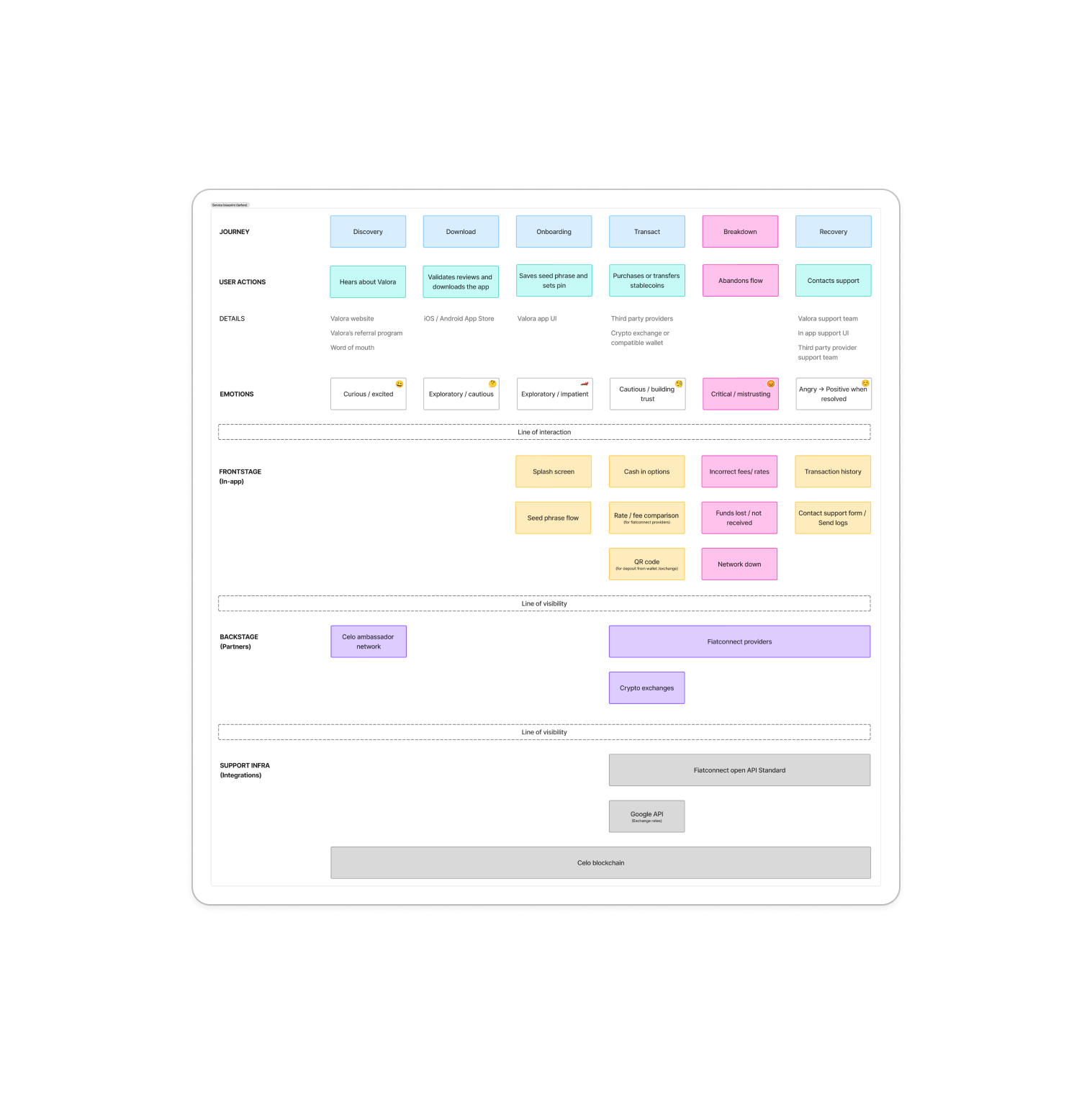
Wallets are only useful if you can get funds in and out. We built Fiatconnect so that third party service providers who already integrate with local banks can integrate with the API and provide purchasing infrastructure to wallets like Valora. The funding for this project came through the Celo Foundation.
Valora needs these providers because without them, users hit a dead end when they need to use their crypto in the real world. Providers using the Fiatconnect benefit from increased transaction volume.
Research Plan
Myself and our small cross-functional team spent 6 days on Victoria Island, conducting 17 user interviews and 5 partnership meetings with local Fiatconnect service providers
Our goals
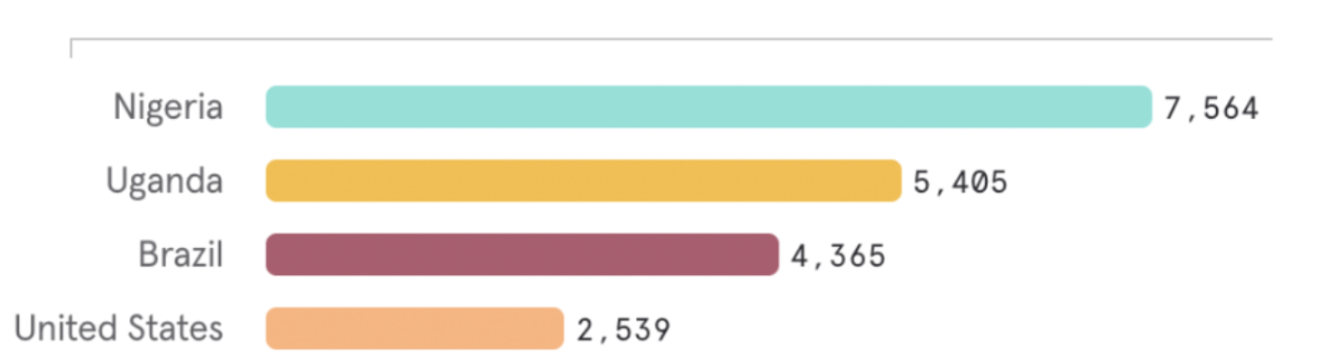
After launching Fiatconnect in January 2023, our quantitative research showed that Nigeria surpassed the US and Latin America in transactions per users.
VALIDATE POSITIVE MARKET SIGNALSCONDUCT USER INTERVIEWSWe wanted to gather cultural and financial context and determine if & where our service and application were breaking down.
STRENGTHEN LOCAL PARTNERSHIPSMeet and build relationships with FiatConnect cash-in/out providers operating in Lagos.
CONDUCT USER INTERVIEWSUser interview cohorts
We interviewed three distinct cohorts of users to gather cultural and financial context, and collect a diversity of perspectives.
7
CURRENT VALORA USERSUsers who were already using Valora, and who could give feedback on the designed experience, and tell us what was & wasn’t working well.
5
People who are actively using other products. We wanted to know what was working well for them and where we could have a competitive edge in the market.
CRYPTO-LITERATE POTENTIAL USERS5
We wanted to learn from people who used other digital banking interfaces, but had trust barriers toward crypto despite some familiarity.
NON-USERS WITH BANK ACCOUNTS
Our backend infrastructure for rates and fees created churn in the in-app transaction experience.
INSIGHT #1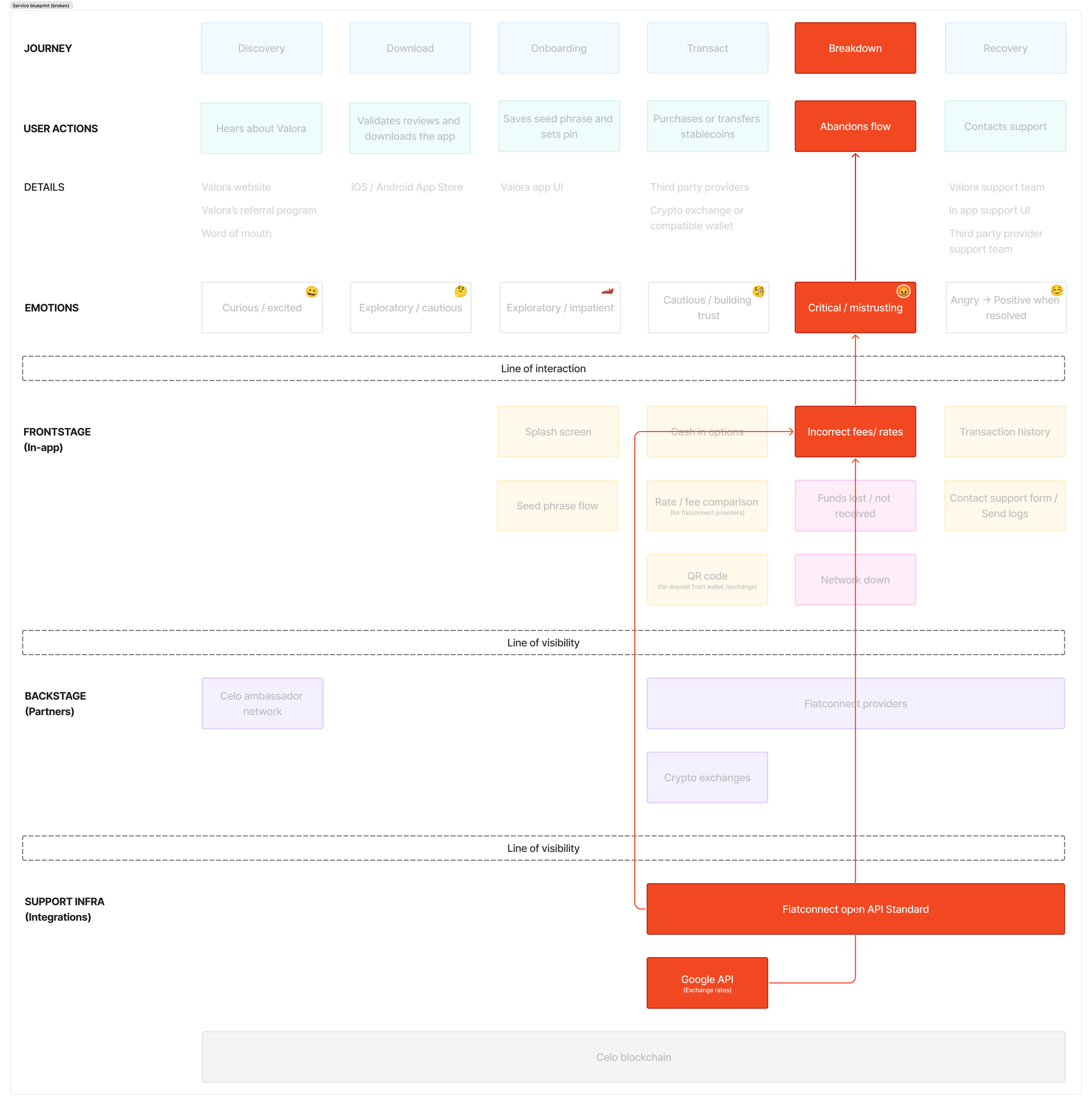
"I feel like I’m being scammed when I see two rates that are so different”
The “hustle” is a big part of making money in Nigeria, and there are many scams.
Seeing discrepancies in between Valora’s rate and Fiatconnect providers tipped users off that there might be some funny business going on, even when we were operating within regulatory constraints.
“Your [exchange] rate is wrong, nobody uses that rate”
Nigeria’s local currency exchanges give an unofficial exchange rate for USD / Naira that is almost double that of the official government rate that is listed in Googles API.
Unfavorable exchange rates for cUSD to Naira early in the transaction UX, was causing churn.
INSIGHT #2“I know I can find a better exchange rate somewhere else”
Despite providers giving competitive rates, usability tests revealed that users were turned off by the rates provided by the Google API, which was tied to the Nigerian government’s official exchange rate.
Using the Google API was not an issue in countries where the currency stayed relatively stable in relation to the dollar, but in Nigeria, where there was a thriving side market to trade local currency, it made sense to use “fair” rates that users were more familiar with.
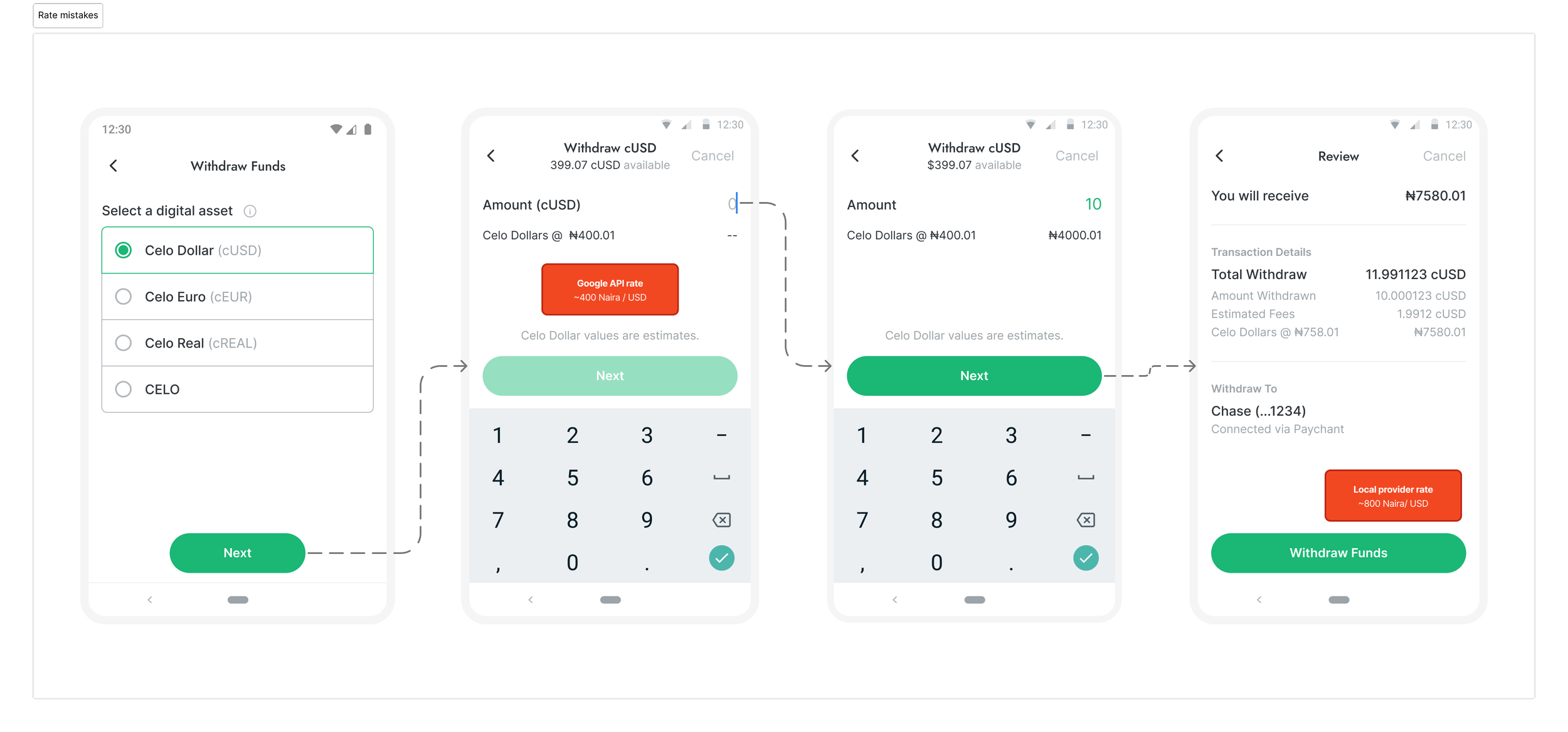
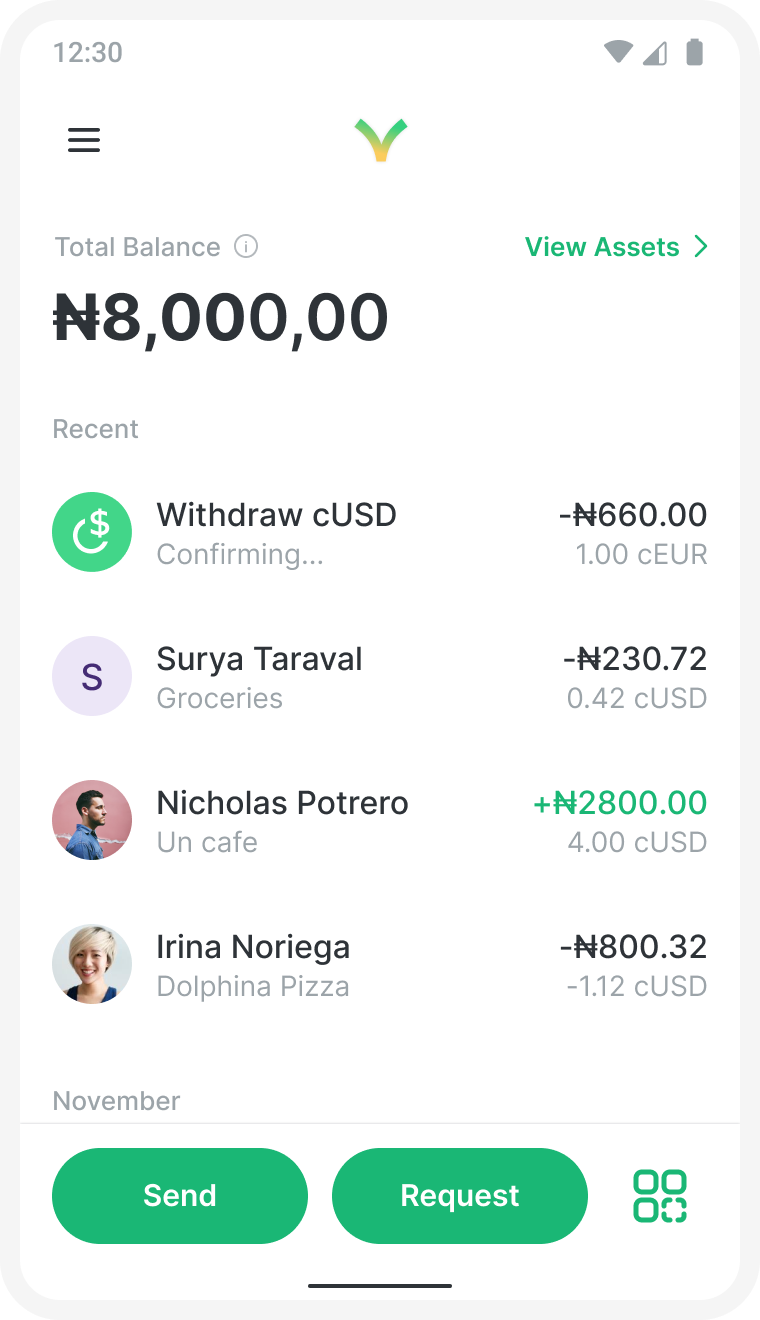
Our convention for denoting decimal places did not extend accurately to Naira balances
INSIGHT #3In usability testing 3/5 users thought they were seeing amounts ten times larger than the actual figure, which caused confusion when scanning balances and reviewing transactions.
We met with Bitmama, Paychant and other Fiatconnect providers, as well as the Nigeria Celo Community Leads
STRENGTHEN LOCAL PARTNERSHIPS
INTEGRATION FEEDBACK
Providers gave critical feedback on their pain points when integrating with the Fiatconnect API.
REGULATORY INSIGHT
We learned about challenges in the regulatory landscape, and workarounds that the teams used to provide crypto based services to the Nigerian people.
CULTURAL CONTEXT
Connecting with local teams more casually, at dinner or while watching live music, gave cultural insights and helped build relationships.
Product design and delivery
DESIGN ROADMAPPING
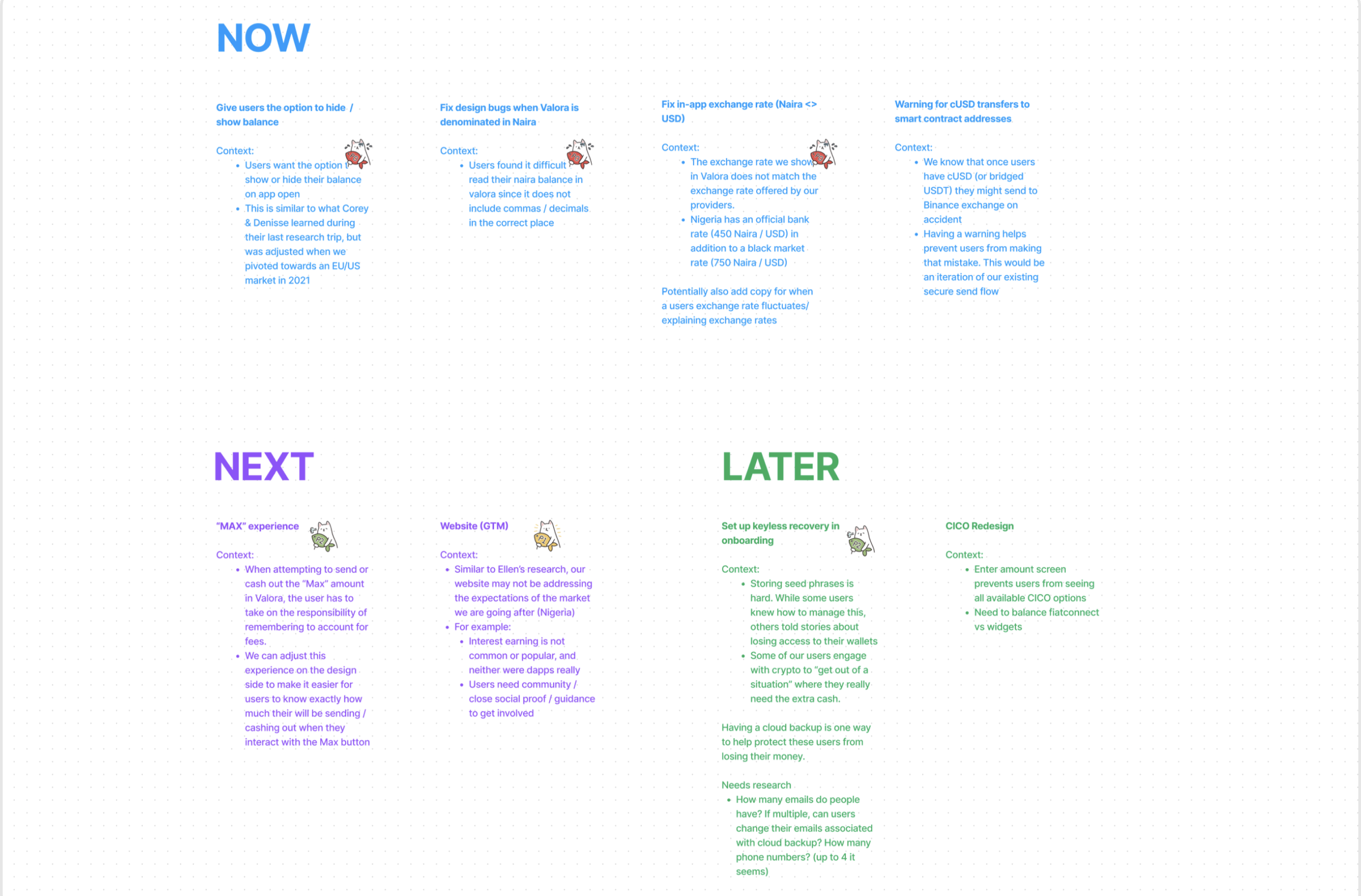
I led a Now/Next/Later roadmapping session to help the team prioritize high- impact design efforts.
I created multiple variants and ran designs through usertesting.com to comprehension test my work.
ITERATION AND USABILITY TESTING
DEFINE SUCCESS METRICS
Cash in success rate and positive usability test results were used to validate the success of the design.
The engineering and product teams were heavily involved in determining final scope and technical constraints around the work.
CROSS FUNCTIONAL FEEDBACK
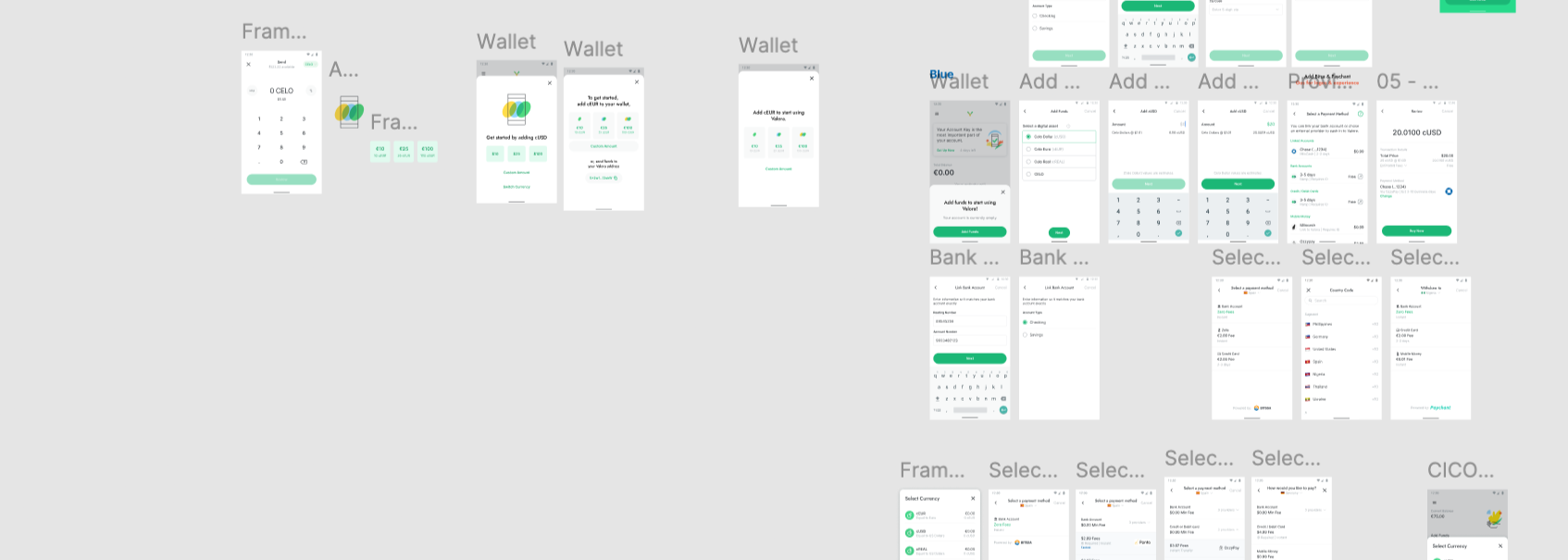
We focused on rate and pricing accuracy, to build trust in Valora and stay consistent with local payment partners.
FINAL DESIGNS
We updated how Naira was visualized in the app to include correct decimal places and local exchange rates
We felt this was important to change ahead of starting marketing efforts in Nigeria.
We clearly called out how much Naira a user would receive after a withdrawal
In usability testing, we saw that users were able to better conceptualize the transaction that they were completing.
Outcome
We launched go-to-market efforts in Nigeria successfully in August of 2023.
We continued to measure cash-in success rates throughout the marketing push, and tackled roadmap requests for our in-product purchasing and withdrawal flows.
Later in the year, another set of team members traveled to visit Lagos, and confirmed that our usability changes had been successful, with the majority of users able to successfully purchase & withdraw funds.